
From WordPress to Astro: The ACIT Migration, Draw by Draw
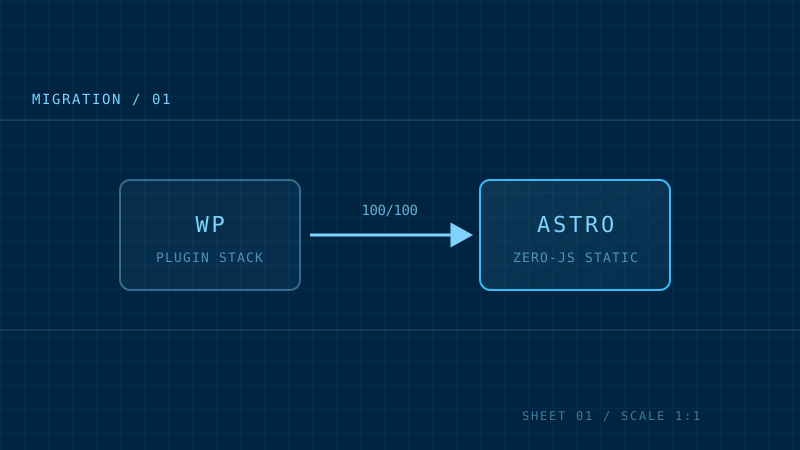
Every real construction project starts the same way: not with a hammer, but with a pencil. The ACIT Géotechnique migration was no different. What looked like a “just move the website” job was, on inspection, a full reconstruction — a WordPress site carrying thirty-odd plugins and a theme that had quietly been doing the thinking for years.
This is that project, told the way I actually run it: phase by phase, from sketch to sign-off.
01 — Esquisse (The Sketch)
The brief was simple: “our site is slow and we don’t know why.” Clients say this a lot. What they rarely mean is what it says on the tin. So the first drawing was not a design — it was a diagnosis.
- Lighthouse audit: Performance in the low 60s, accessibility in the 70s.
- Bundle: hundreds of kilobytes of render-blocking CSS and JS, most of it from plugins the site didn’t even use on the page being loaded.
- Stack: WordPress, a commercial theme, and a plugin inventory that read like a catalogue rather than a plan.
The diagnosis told me what the real project was. Not a reskin. A migration.
02 — APS (Schematic Design)
An architect doesn’t redraw walls and call it a plan. I had to decide what the building actually needed, and what it could do without.
- Keep the content — every word, every image, every service page.
- Keep the meaning — the site had to stay an authority in its field.
- Cut everything else: the theme’s unused components, the plugin bloat, the JavaScript that existed only to animate a menu.
The decision was Astro. Static by default, zero JavaScript unless a page truly needs it. For a content-driven site like ACIT, that means the browser downloads HTML and CSS — and almost nothing else.
03 — APD (Design Development)
Now the plan got detailed. Every wall, every wire, every interaction.
- Design system: I rebuilt the visual language — colors, typography, spacing — so the new site felt like the old one, but sharper. Continuity matters; clients don’t want to feel like the building was replaced, only repaired and upgraded.
- Content model: Every page mapped to a real content structure. No orphaned sections, no half-finished pages hiding in the old CMS.
- i18n: French and English handled natively, with no translation plugin dragging the page down.
04 — DCE (Construction Documents)
This is the phase that separates a real project from a weekend template drop. Before a single line shipped, I wrote the documents that govern the build: the component inventory, the routing plan, the performance budget.
The performance budget was the contract. Every page had to hit 100/100 on Lighthouse — or it didn’t leave the workshop. No exceptions, no “good enough for a corporate site.”
05 — Chantier (The Build)
With the drawings complete, construction began. Astro components, Tailwind for styling, Bun for the toolchain, deployed to the Cloudflare edge.
The old WordPress site asked the browser to run a small application to display a brochure. The new Astro site sends static HTML and lets the browser rest. That single architectural decision removed the need for almost all the JavaScript that was slowing everything down.
06 — Livraison (Handover & Sign-off)
The final inspection is not optional — it’s the whole point. The handover included:
- Lighthouse: 100/100 across performance, accessibility, best practices, and SEO.
- Punch list: any remaining issue, however small, fixed before signature.
- A site the client can actually own: no plugin subscriptions, no locked-in theme, no hostage to a licence that expires next year.
The ACIT site now loads almost instantly, ranks better, and — critically — costs almost nothing to maintain. That’s the difference between handing over a building and handing over a responsibility.
The honest part
I don’t show you this because the tools are magic. Astro, Tailwind, Bun — these are just materials. The real work was the same as any construction project: decide what to build, document it, then build it with discipline. A fast website is not a technology. It’s a decision, made early and defended to the end.